Tuesday, November 30, 2010
Jaws 3D! (Now with less sharks)
What strikes me the most about my source material, Back To The Future, is the fundamental misunderstanding Marty has about the past, in particular- their technology. He struggles to open a glass coke bottle, the jukebox is a mystery, while he believes he knows what the past is- he has no idea what the time is like outside of generalization and stereotypes.
We currently live in the time of Avatar, 3D TVs available to the masses, even Justin Beiber's movie is premiering in 3D (if that doesn't scream The End Is Nigh, I don't know what does). In as little as 30 years out, I believe people will view our time as a people obsessed with creating false images and though the standard Blue/Red glasses have become passe to us (we've moved onto the all black Buddy Holly type glasses)- that's the immediate association with 3D and it would be easy to confuse our time as one wearing those around.
Deliverables:
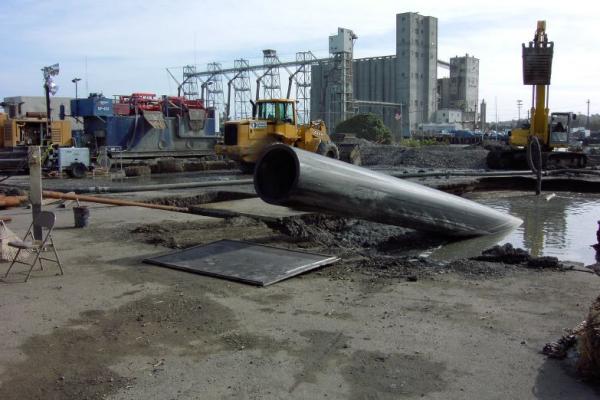
Creating a set of digital images composed of 3D images of trash in Islais Creek (what's left of it) in 500 years. These will be viewable using 3D glasses and they will be displayed on a digital photo frame which rotates through the images.
The majority of waste we found in our explorations during the midterm were paper (mostly food wrappers), plastics, and e-waste. I'd like to reflect how the future will handle these items, I'm assuming food and packaging will continue to be important to humans even 500 years in the future.
I'm working with Kate (kind of) in that our projects are operating under the same universe, like how all Kevin Smith films are interrelated to each other. Our grand scheme is optical illusions in displaying information. I'm focusing on what would be the more 'advanced' optical illusions.
Rough Example:
Sunday, November 28, 2010
I was never good at feelings (Glen Canyon Park Presentations)
The Glen Canyon Park presentations was a unique opportunity to display the work we have created over the course of our semester to real people. Real people!
Not that our class isn't real people, but you know, people who aren't people who have been focused on watersheds since September.
Besides logistical problems (the room was quite cramped, the librarians attitudes towards us rivaled that of elderly Catholic nuns armed with metal rulers, that projector had seen better days) I think it went really well. The audience was engaged, they seemed excited when they actually recognized places around SF that we had investigated, and all of the work was well recieved.
It was a new experience for me, as I usually only present to people within the DAI major who understand work as a process, rather than to people who are just critically evaluating the end product with no further knowledge of the steps it has undergone. I'm excited for the gallery showing at the end of this semester, where we can hopefully still invite people from the public to mingle with those that have witnessed the entire design process and I can get very different feedback from multiple resources.
Not that our class isn't real people, but you know, people who aren't people who have been focused on watersheds since September.
Besides logistical problems (the room was quite cramped, the librarians attitudes towards us rivaled that of elderly Catholic nuns armed with metal rulers, that projector had seen better days) I think it went really well. The audience was engaged, they seemed excited when they actually recognized places around SF that we had investigated, and all of the work was well recieved.
It was a new experience for me, as I usually only present to people within the DAI major who understand work as a process, rather than to people who are just critically evaluating the end product with no further knowledge of the steps it has undergone. I'm excited for the gallery showing at the end of this semester, where we can hopefully still invite people from the public to mingle with those that have witnessed the entire design process and I can get very different feedback from multiple resources.
Thursday, November 18, 2010
Final Proposal: "Doc, I have to tell you about the future!"
When Marty McFly returns to his present day life in Hill Valley after spending a week in a Hill Valley circa 1955, he finds that life has become exponentially better for him. His family has gotten their act together, they've pursued successful careers, Biff waxes the family cars instead of terrorizing them. Ultimately, Marty uses the butterfly effect to his advantage and his teenage shenanigans improve his situation, improve others.
And I'd like my final project to be Marty McFly, a warning from the future.
I don't plan on building a Delorean, nor a time machine, nor could I even begin to quantify what a 'jigawatt' is. I would, however, like my final project to be a vision of the future of the garbage of Islais Creek, one that if sent back in time (our present day) could ultimately affect the future.
These installments of future warnings I'm calling "McFlys". I would like to construct garbage of the future, make documentation of it, and then 'send them back in time' to our present day. Thus altering the space time continuum for what I hope is the better.
I'm taking a slightly dystopian view of the world based on work such as Atlas Shrugged by Ayn Rand, Clockwork Orange by Anthony Burgess, 1984 by George Orwell, and Back To The Future 2 by Robert Zimekis. The trash created and documented will be connect to the refuse recovered from my midterm project such as categories of trash, which have remained a problem (do we still use paper in the future?) and what that trash looks like now.
Tuesday, October 26, 2010
Midterm Rough Draft Ideas: Infographic Board
Look at your project. Now back to mine. Now back to your project. Now back to mine.
Sadly, your project is not about trash. But it could be! (If you threw it in the garbage.)
Midterm Rough Draft Ideas: Postcards
What better way to show a facsimile of a particular area than with postcards?
We were thinking of sending them to MUNI to see if we couldn't get someone to clean up the area of the creek that they seem to own operate/neglect. I wanted to try doing postcards from different eras to show just how long this has been a problem with 'Shit Creek'.
These postcards could be digital and hardcopy. They may be used in conjunction with the google earth walking tour kmz file.
Tuesday, October 19, 2010
Sunday, October 17, 2010
Thursday, October 7, 2010
Behold, My Eye.
Pretty Maps by Cope
Inherently, landscape is difficult to write about. Walden gets pretty close of capturing the majesty of nature (and the hermit lifestyle, thanks Thoreau.) Our reading, The Beholding Eye, by D.W. Meinig attempts to approach landscape in it's many forms. As nature, habitat, artifact, system, problem, wealth, ideology, history, place, and finally- aesthetic.
But I have to be honest, Meinig sets out to describe, "some of the different ways our varied group might describe a common scene," (34) but does this in the most convoluted terms he could scrape up. It's a difficult reading to get through. Not only because of word choice, but because of his metaphors are a hyperbole and a half. This is not to diminish his points, which are well-thought out, just not articulated well for anyone as patient as the man he describes as, "minuscule, surfical, ephemeral, [and] subordinate" (34).
He begins by outlining the view of landscape as nature, a clear strike at the aforementioned Thoreau. Landscape is nostalgic and that we all secretly wish to remove our impact from the world around us to restore the beauty that is a natural state of Earth. He spends a few paragraphs, it seems, almost casting these people as hopeless romantics with no other motivation but wax and wane about what used to be. When it comes to landscape as artifact, man is the shaper of Earth, the planet just a stage for our furniture and follies. Man is both the creator and and conqueror- and this, seems to be more noble a role than the man obsessed with what nature used to be.
What I found most interesting about this reading, is landscape as aesthetic as it deals the closest with what we have approached in class. Especially his quote, "It rests upon the belied that there is something close to the essence, to beauty and truth, in the landscape. Landscape becomes a mystery holding meanings we strive to grasp but cannot reach," (46). I believe our class most closely reflects this idea as we seek to define a particular space of Islais in this midterm. We must balance between being the hopeless romantics of landscape and the conquerors of it.
Tuesday, October 5, 2010
Continuing Research
For first hand documentation, please see Amber's blog: http://retrievingbabylon.blogspot.com/
Because I am having an incredibly difficult time getting off campus to participate in some first hand documentation- I've tried to focus my efforts into identifying what some alternative methods to dealing with garbage are. The first videos documents the 'garbage cycle', chronicling how we traditionally dispose of trash. The second focuses on the interception of this garbage and how artists are reforming the idea of when things are obsolete. I would personally like to see our documentation turn into a sort of 'What Can I Make With The Garbage of Glen Canyon Park'.
I am excited that this week marks the first time (since almost August) that I'll be able to leave the bubble of SFSU for an entire day (!) and get out into the field.
Tuesday, September 28, 2010
The Garbage Project
Let me preface my proposal with a short anecdote which only covers a mere three years and two months of my life but still averages out to roughly 14% of my total time on Earth.
I work for SFSU Housing. And you know this already. Because when you work for SFSU Housing, you bring it up at every time it is even minutely relevant. Because it is where you live, where you work, where you eat, where you go to school. It is a mile wide bubble that you learn to conduct all of your daily business in, and rarely do you leave the bubble. Thus the things in the bubble become fiercely important to you.
Even your garbage.
My specific floor has two rooms in the lobby. One for trash and one for recycling. And I can I tell the entire state of my floor by how those two rooms are kept. I know when rooms haven't been around because the trash room is bare. I know who has been breaking policy by the number of alcohol bottles nestled in the bottom of the recycle bin. My residents fall just short of calling me a sociopath in the way I can evaluate their lives by the jenga game peeking out from the top of their trash bin.
Garbage tells me what my residents can't or don't even realize themselves yet.
Islais Creek is similar in that it cannot tell us what is happening to it, it can only show us. Both by the refuse being left behind by companies or individuals, but also what 'waste' the creek itself is making in excess.
For my midterm project I would like to catalog the waste in a particular subsection (to be determined with my group, as I missed last week because I could not get over this flu) of Islais Creek. We would categorize the types of waste we find, also documenting its surroundings, and discover if we are ignoring 'hidden populations' along the Islais Creek. (Such a case is documented here.)
Islais Creek has garbage in it's history:
"In the late-1800s what’s now called Bayview emerged as Butchertown, an epicenter of slaughterhouses. The creek was used to carry offal into the bay. Soon the water became polluted. Landfill and heavy industries followed. Islais Creek became narrower and filthier. By the 1950s, automobile scrap yards littered the area and the City was releasing untreated sewage into the channel, which had become known colloquially as Shit Creek. Two hundred years ago the creek’s mouth was two miles wide. Now it’s roughly the length of a city block." -Neighborhood NewswireIslais, then, cannot be understood fully, without taking into account the effect garbage has had on its development, decline, and present day state. By analyzing the refuse both left and created in this creek, we can create a view of Islais as has been directly shaped by man.
Example Infographics on Garbage:
Subscribe to:
Comments (Atom)